Roboter lernen von Menschen.Wir bauen die Plattform dafür.
Die erste Runde kam von Angels aus dem persönlichen Umfeld und ist geschlossen. Jetzt öffnen wir Runde zwei: 300.000 €, Close am 17. November 2026.
Build the foundation of AI-Robots.
The bottleneck is demonstration data
Policies like ACT, SmolVLA, Pi0.5 and GR00T learn from recorded human demonstrations. Recording them is the slow, manual part. AY-Robots turns that into a marketplace.
Vision-language-action models do not learn a task from a description. They learn from episodes: a human moves the robot arm through the task while cameras and joint encoders record every frame. A single policy for one gripper task needs dozens of episodes, and every episode has to be recorded on a real arm by a real person. Labs solve this with students and patience, which does not scale. That is the bottleneck: the models are available as open weights today, an arm costs a few hundred euros, but demonstration data is still produced by hand, task by task.
AY-Robots puts the four pieces together. Arm owners connect an SO-100, SO-101, Koch or WidowX via the desktop client and release time slots. Operators take over the arm via WebRTC and record episodes in LeRobot v2.1 format with up to five cameras at 30 fps, at country rates of 8 to 22 euros per hour with a 20 percent platform share. Finished datasets sell on the marketplace at a 10 percent commission. The platform then trains ACT, SmolVLA, Pi0.5 and GR00T on rented GPUs and serves the checkpoint as a cloud endpoint driving a real arm, billed by the minute.
All of that runs today: a real SO-100 is controllable at /live, the client records and uploads, the training pipeline covers five policy architectures, and the MCP server lets Claude or ChatGPT operate the arm directly. What is missing is capacity. Round two therefore goes into our own robot cells, reserved GPU capacity and more arms and operators, so that a company can order a dataset for its task and get a working policy back without building a lab first. The goal is the data and compute layer robot learning needs, as speech models needed transcribed audio.
Interesse bekunden
Unverbindlich - wir melden uns persönlich mit den Details.
Unverbindliche Interessensbekundung, kein öffentliches Angebot, keine Anlageberatung. Ein etwaiges Beteiligungsangebot erfolgt ausschließlich individuell und mit vollständigen Unterlagen.
Was schon steht
Wachsende Adoption in der Open-Source-Robotik-Community - Startups, Studierende und Unis arbeiten mit der Plattform
5 Policy-Architekturen (GR00T, Pi0.5, SmolVLA, ACT) über eine Trainings-Pipeline
Echter SO-100 live im Browser steuerbar - Teleoperation mit 30-70 ms Latenz
Cloud-Inferenz: Checkpoints fahren echte Arme, minutengenau abgerechnet
Dataset-Marketplace + MCP-Server: Claude, ChatGPT & Co. bedienen den Arm direkt
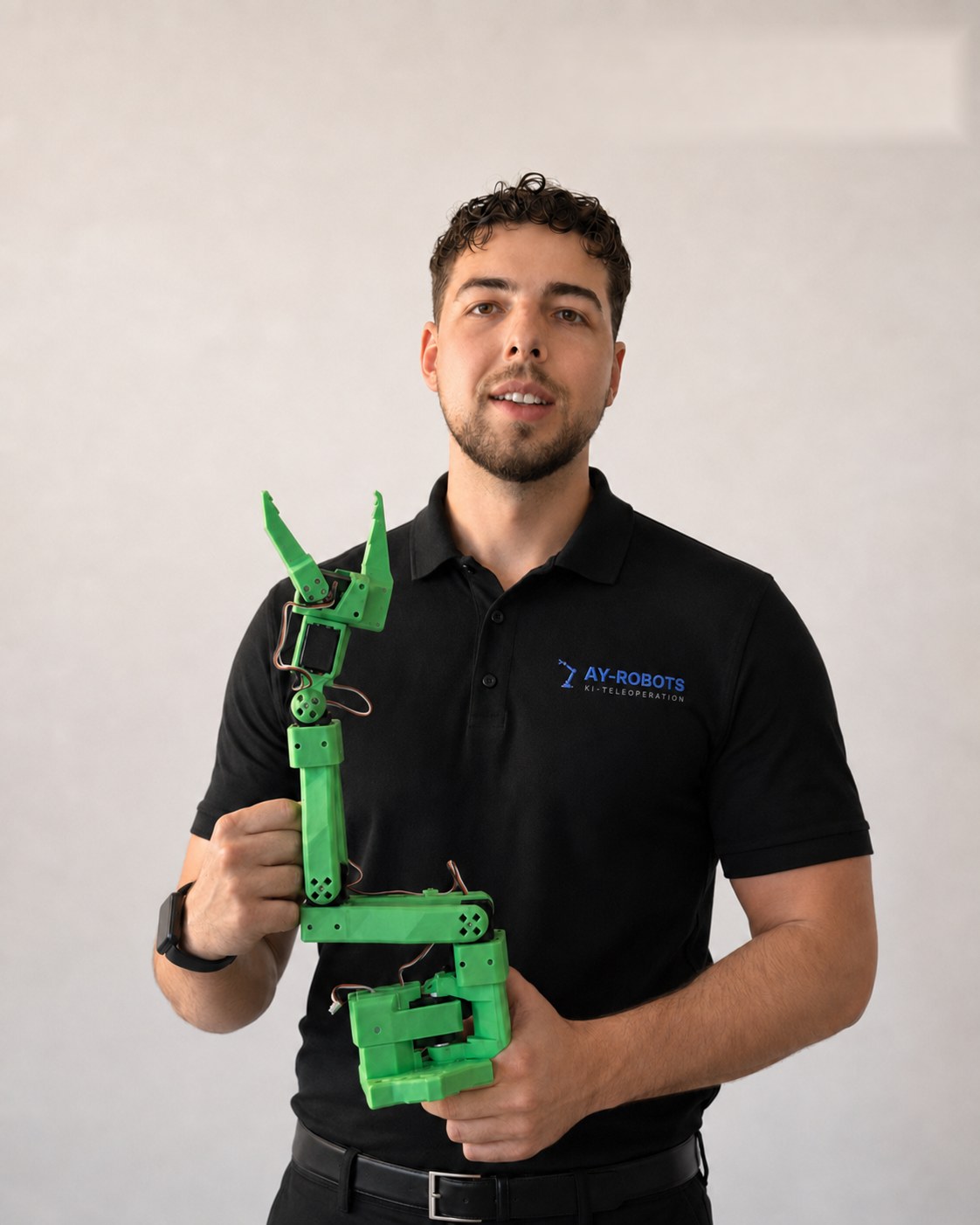
Wer dahinter steht

- Januar 2026Erste Prototypen live - ein SO-100 lässt sich über den Browser fernsteuern.
- Frühjahr 2026Plattform-Aufbau: Desktop-Client, geführte Datenaufnahme, Cockpit für Remote Data Collectors.
- Sommer 2026Fünf Policy-Architekturen laufen durch eine Trainings-Pipeline, Cloud-Inferenz fährt echte Arme.
- August 2026/live öffentlich, Dataset-Marketplace und MCP-Server für KI-Agenten.
- September 2026Runde zwei öffnet - Kapazität skalieren statt Konzept beweisen.
Zwei Brüder, ein Betrieb - vom ersten Prototyp bis zur Plattform in unter einem Jahr.
Was mit der Runde passiert
Das Kapital fließt fast vollständig in kapitalintensive Bereiche (CapEx): Roboterzellen, Arme und reservierte GPU-Kapazität - Werte, die bleiben, statt laufender Kosten.
Eigene Roboterzellen
100k €Zellen bauen und betreiben - komplexe Embodiments, Low-Latency-Tasks, mehrere Standorte.
GPU-Kapazität sichern
90k €Reservierte GPUs für Training und Inferenz - berechenbare Verfügbarkeit und Preise statt Spotmarkt-Lotterie.
Scale-up Remote Operations
60k €Mehr Kapazität an Remote Data Collectors, echte 24/7-Abdeckung - der Engpass ist Kapazität, nicht Nachfrage.
Roboterarme
40k €Mehr Arme, mehr Armtypen - im Netz, im Client, im Training. Es sind nie genug Arme.
Claude-Subscriptions
10k €Unser produktivstes Teammitglied baut die Plattform mit. (Haha. Aber wirklich.)
Marketing
0 €Null. Das beste Marketing ist ein Produkt, das funktioniert.
Geplante Verteilung - die endgültige Allokation besprechen wir mit den Investoren der Runde.
Für Firmen: strategisch beteiligen
Neben dem klassischen Ticket arbeiten wir mit Unternehmen, für die Robotik-Daten und Teleoperation strategisch sind - von Pilot bis Integration.